
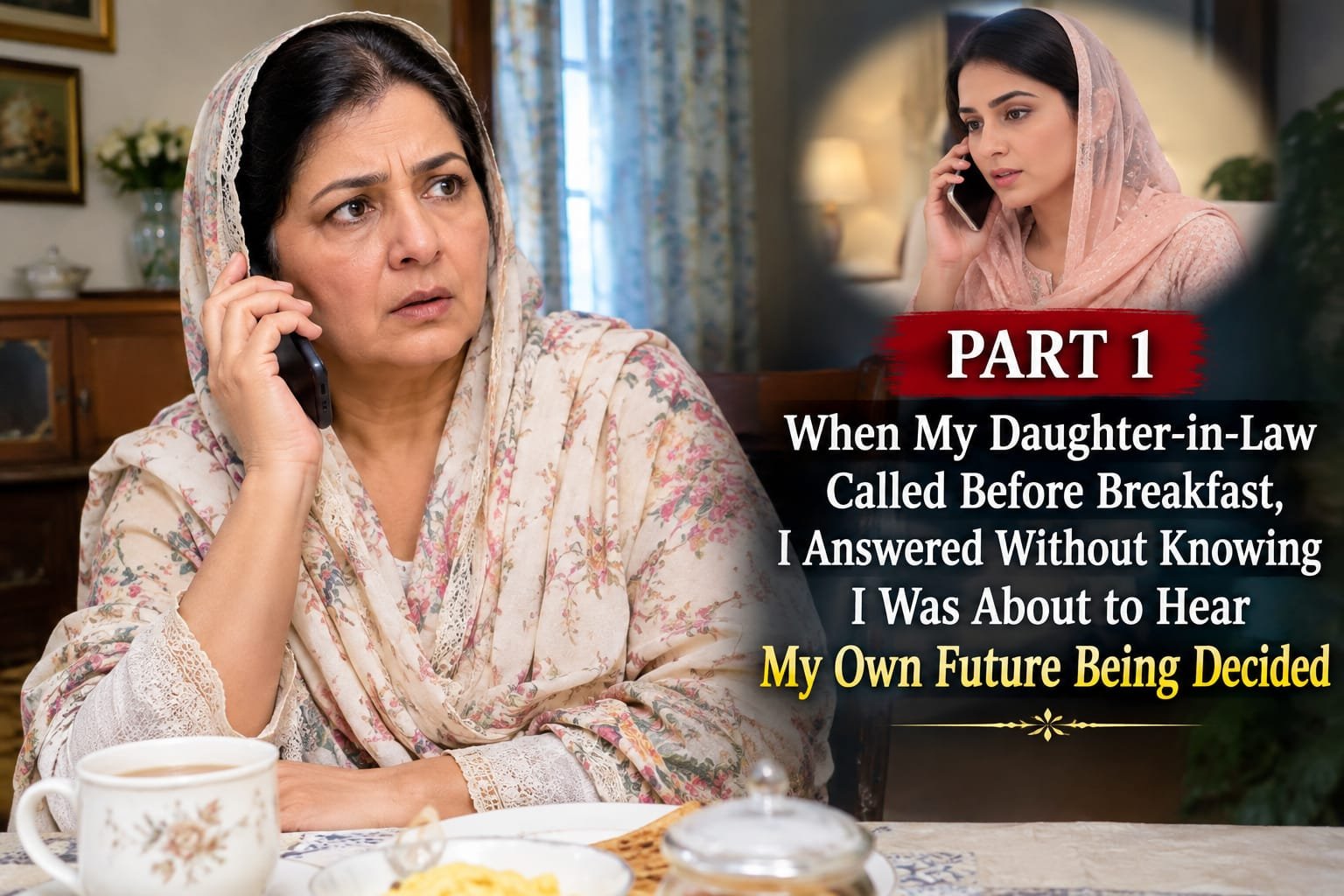
The phone rang at 6:17 on a Tuesday morning.
I remember the exact time because I had just finished pouring myself a cup of tea. The kitchen was still quiet, the morning sunlight had barely reached the curtains, and the house smelled of cardamom and freshly toasted bread.
At seventy-two, I had grown accustomed to quiet mornings.
My husband, Robert, had been gone for four years. My son, Daniel, lived twenty minutes away with his wife, Melissa, and their two children. They visited when their schedules allowed, usually on Sundays, although even those visits had become less frequent over the past year.
I never complained.
Children had their own lives. I understood that.
At least, that was what I kept telling myself.
When I saw Melissa’s name flashing across my phone screen, I frowned.
She rarely called before eight, and when she did call, it was usually because one of the children had forgotten something at my house.
I answered with a smile in my voice.
“Good morning, sweetheart. Is everything all right?”
There was no greeting in return.
Instead, I heard Melissa speaking to someone else.
“She’s probably awake by now,” she said. “She always gets up early.”
I pulled the phone away from my ear and checked the screen.
The call was connected.
“Melissa?” I said.
She didn’t answer.
Then another voice came through, low and impatient.
It was my son.
Daniel.
“Just get it over with,” he said. “We can’t keep putting this off.”
I froze.
For a moment, I wondered whether I had accidentally answered a group call or whether my daughter-in-law had somehow forgotten I was on the line.
Then Melissa spoke again.
“The problem is that your mother thinks everything belongs to her forever. The house, the money, even your time. She’s never going to agree unless we make her understand that things have to change.”
My hand tightened around the phone.
The house?
What was she talking about?
I had owned my home for thirty-eight years. Robert and I had bought it when Daniel was only five, back when the roof leaked during heavy rain and the kitchen floor had a crack we couldn’t afford to repair.
We had worked hard for everything we had.
Robert had spent thirty years as a mechanic. I had worked at a local school cafeteria until my knees forced me to retire. We had saved every spare dollar, gone without expensive vacations, and learned to celebrate birthdays with homemade cakes rather than restaurant dinners.
When Robert died, he left me the house, his savings, and a small life insurance policy.
Nothing extravagant.
But enough to live comfortably without depending on anyone.
And I had always believed that was precisely what Robert wanted for me.
Independence.
Security.
Peace.
Now I was standing in my kitchen, listening to my own son discuss my future as if I were a problem that needed to be solved.
“Daniel,” Melissa continued, “we have two children. We need more space. The mortgage is killing us, and your mother has three bedrooms she barely uses.”
I stared at the ceiling.
My house had three bedrooms, yes.
One was mine.
One had belonged to Daniel when he was growing up, and I had kept it almost exactly as it was after he moved out. The third was Robert’s study, where his books, old photographs, and wooden toolbox still sat on the shelves.
I had never thought of those rooms as wasted space.
They were memories.
But apparently, to Melissa, they were square footage.
Daniel sighed.
“I know.”
“Then why are we still discussing it?” she demanded. “We could sell this place, pay off our mortgage, and buy something bigger. Your mother could move into a smaller apartment or one of those retirement communities.”
My tea suddenly tasted bitter.
Sell this place.
My home.
The house where I had raised Daniel, where Robert had carried our newborn son through the front door, where we had celebrated twenty-seven Christmas mornings together before illness began taking pieces of my husband away.
I wanted to shout.
I wanted to tell them I was still alive, still capable of making my own decisions, and certainly not ready to be packed away somewhere because my daughter-in-law wanted a larger kitchen.
Instead, I remained silent.
Perhaps I was afraid of what I might hear next.
Or perhaps, deep inside, I already knew.
Then Daniel said something that made my knees weaken.
“Mom won’t like it, but we don’t necessarily need her permission for everything.”
I stopped breathing for a second.
Melissa lowered her voice.
“That’s why we need to handle it before she changes her will.”
My will.
I had updated it six months earlier, after my doctor warned me that my blood pressure was becoming difficult to control. I had appointed Daniel as the person who could help manage certain affairs if I ever became unable to handle them myself.
It seemed sensible at the time.
He was my only child.
Who else would I trust?
Apparently, I had answered that question too quickly.
“What if she refuses?” Daniel asked.
Melissa didn’t hesitate.
“Then we talk to a lawyer. We explain that she’s getting older and that living alone isn’t safe anymore. We can make the argument that she’s no longer capable of managing everything by herself.”
I felt the kitchen tilt around me.
I reached for the edge of the counter.
For years, I had worried about becoming a burden to my son. I had rehearsed conversations in my head about accepting help gracefully, moving closer to his family, and making sure I never interfered with their lives.
Never once had I imagined that my own child might consider using my age against me.
Then Daniel asked the question I would remember for the rest of my life.
“And what happens to Mom if we get the house?”
Melissa paused.
When she answered, her voice was almost cheerful.
“We’ll figure something out. She has her pension. She’ll be fine.”
She’ll be fine.
Three words.
That’s all I was worth in their conversation.
Not a mother who had stayed awake through fevers, sat beside hospital beds, and worked extra shifts to pay for school supplies.
Not a widow who had spent four years learning how to sleep in an empty bed.
Not a woman who had spent her entire life trying to give her family a place where they would always be welcome.
Just someone who would be fine.
Daniel spoke again.
“There’s one more thing. If we do this, we need to get her to sign the papers before she talks to Aunt Susan. You know how she gets when Susan starts asking questions.”
My sister, Susan, had been telling me for months that something about Melissa’s behavior didn’t feel right.
I had defended my daughter-in-law every time.
“She’s under pressure,” I had said.
“Raising children is difficult.”
“Daniel has a demanding job.”
“You’re reading too much into it.”
Now I wondered whether Susan had seen something I had refused to see.
Melissa continued.
“I already told her we should all sit down together this weekend. I’ll bring the documents, and you can explain that it’s the best decision for everyone.”
“And if she asks why everything needs to happen so quickly?”
“Tell her the market is changing. Tell her we’re worried about her being alone. Whatever you need to say.”
There was a brief silence.
Then Daniel asked, “And the bank account?”
My stomach twisted.
“What about it?” Melissa replied.
“The savings account Dad left her. If the house gets sold, she’ll have enough money to live on. But if we can get her to add me to the account now, it’ll make everything easier.”
I closed my eyes.
Robert had left me a modest investment account in addition to the insurance money. I had never told Daniel exactly how much was in it because I didn’t believe he needed to know.
It wasn’t a fortune.
But it was my safety net.
The money I had promised myself I would never touch unless I needed medical care, help at home, or somewhere safe to live if I could no longer manage the house.
And my son was already discussing how to get his name on it.
“Daniel,” Melissa said, “you need to stop feeling guilty. We’re not stealing from her. We’re family. Everything will eventually come to you anyway.”
I nearly dropped the phone.
Eventually.
That word carried a terrible certainty.
As if my death were merely an inconvenience they were planning around.
Then Daniel said, “I just don’t want her to hate me.”
For one foolish second, hope stirred in my chest.
Perhaps he still understood what he was doing.
Perhaps he would tell Melissa to stop.
Perhaps he would remember the woman who had once sold her wedding ring to pay for his college textbooks when Robert’s hours were cut.
But Melissa’s answer crushed that hope.
“She’ll get over it. She’s your mother. She’ll always forgive you.”
I pressed my free hand against my mouth.
Because she was right about one thing.
I had always forgiven Daniel.
When he forgot my birthday, I told myself he was busy.
When he canceled Sunday dinner at the last minute, I packed the food into containers and told myself the children needed their rest.
When he went three weeks without calling, I found excuses for him.
I had spent years making his life easier by pretending that his absence didn’t hurt.
And now he was counting on that same forgiveness to help him take away the life I had built.
I wanted to end the call.
I wanted to throw the phone into the sink.
Instead, I kept listening.
Then Melissa said, “There’s something else we should discuss before we talk to her.”
Daniel sounded irritated.
“What now?”
“The medical evaluation.”
My heart began pounding.
“What medical evaluation?” Daniel asked.
“The one I mentioned last week. If we can get her doctor to document concerns about her memory, it’ll make everything easier. We don’t have to wait for something bad to happen before we act.”
I stared at the photographs on the refrigerator.
There was Daniel at twelve, holding up a fishing rod.
Daniel at eighteen, smiling in his graduation gown.
Daniel at twenty-eight, standing beside Melissa on their wedding day.
I remembered every one of those photographs being taken.
Every detail.
Every laugh.
Every promise.
And suddenly, I understood the real danger.
They weren’t merely planning to persuade me to sell my house.
They were discussing how to make my refusal seem like proof that I could no longer make decisions for myself.
“Do you think the doctor will go along with it?” Daniel asked.
“I don’t know. But we should try. If she starts getting confused, people will believe us.”
I had never been confused.
I occasionally misplaced my reading glasses. I sometimes forgot why I had walked into a room, as most people did when they were tired. But I balanced my checkbook every month, paid my bills on time, remembered every appointment, and drove myself to the grocery store twice a week.
I was seventy-two.
I was not helpless.
And I was certainly not incapable of deciding where I would live.
I drew a slow breath.
Then I heard the sound that finally made me move.
Melissa laughed.
It wasn’t a nervous laugh or an uncomfortable one.
It was the casual laugh of someone discussing a minor inconvenience.
“Honestly, Daniel, once the paperwork is done, she’ll have to accept it. What else can she do?”
I looked toward the window.
Outside, the roses Robert had planted were beginning to bloom. He had always said they were stubborn flowers, the kind that survived even when the weather turned against them.
I had laughed at him then.
Now I understood what he meant.
My husband had spent the last months of his life worrying about me.
“Promise me something,” he had whispered one evening from his hospital bed.
“Anything,” I had answered.
“Don’t let anyone make you feel like you don’t belong in your own life.”
At the time, I thought he was speaking about grief.
I thought he was afraid I would stop going out, stop seeing friends, and stop enjoying the little things that had made our marriage beautiful.
I never imagined that, four years later, his words would become a warning.
My hand stopped