Nature is full of unexpected moments, and a short wildlife video can sometimes capture the incredible tension between animals in just a few seconds. A dramatic clip showing a monkey near a crocodile on a muddy riverbank has caught attention because it highlights the dangers animals can face while searching for food, water, or a safe place to move.
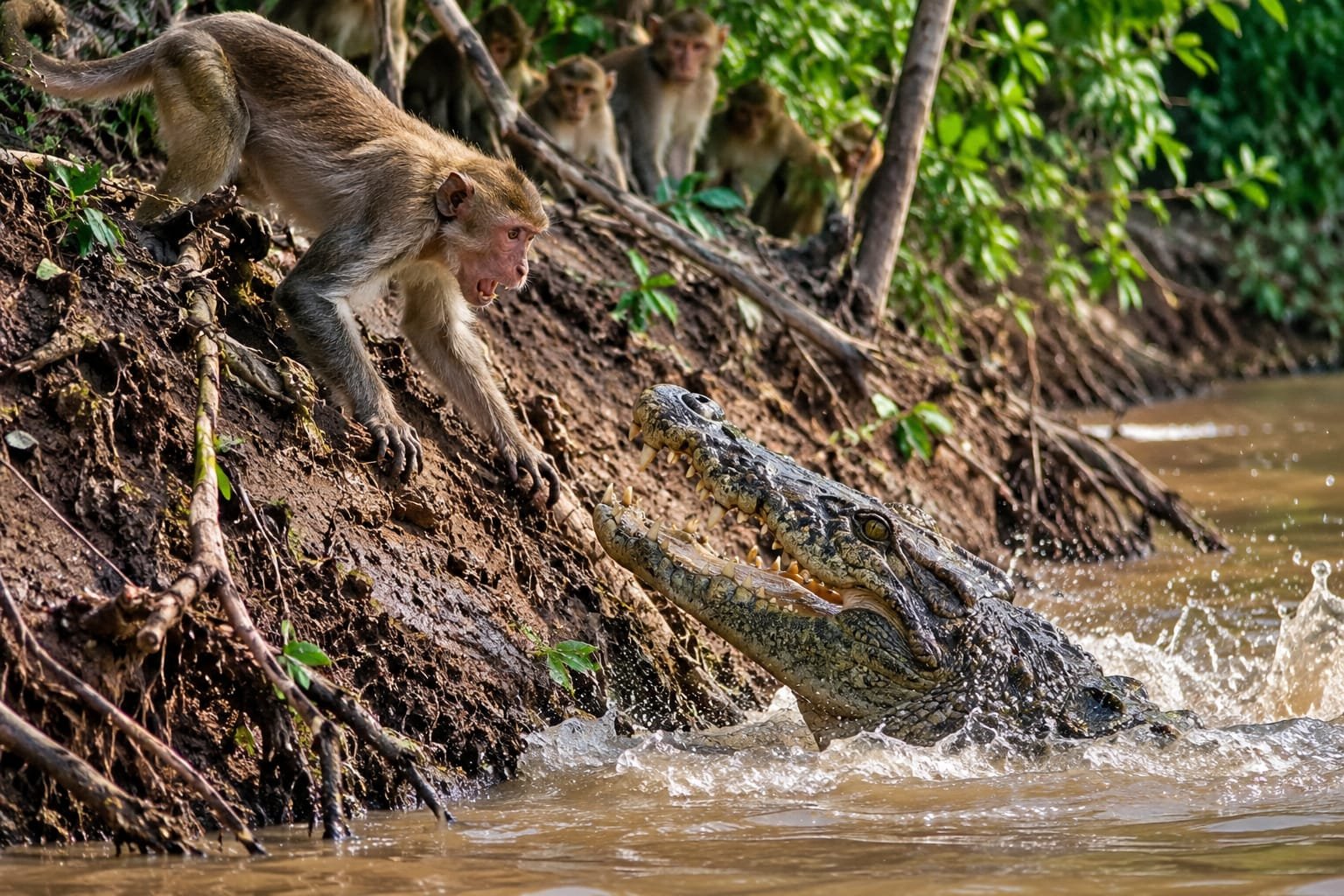
The footage shows a monkey standing close to the edge of a river while a crocodile lies partly in the water below. Several animals appear to be gathered on the bank as the situation becomes increasingly tense. Suddenly, the water splashes violently, turning an already dangerous encounter into a startling wildlife moment.
Although the short video does not reveal the complete story behind the encounter, it offers a powerful reminder that life in the wild can change in an instant.
A Dangerous Meeting at the Water’s Edge
Rivers are essential to wildlife. They provide drinking water, food, and access to different parts of an animal’s territory. However, riverbanks can also be dangerous places, particularly when predators such as crocodiles are nearby.
At the beginning of the video, a monkey is visible on a steep, muddy bank covered with roots, branches, and vegetation. A crocodile can be seen close to the water’s edge below it.
The distance between the animals appears remarkably small. The uneven ground makes the situation even more concerning because the monkey has limited space to move around safely.
Crocodiles are well adapted to life in and around water. Their ability to remain partially submerged allows them to approach prey without being easily noticed. Monkeys, meanwhile, rely on their agility, quick reactions, and ability to climb when escaping danger.
When these two very different animals come close to one another, the encounter can become unpredictable.
Why Crocodiles Are Such Effective Predators
Crocodiles are among the most successful aquatic predators in the animal kingdom. Their bodies are designed for moving through water, and their eyes and nostrils allow them to remain near the surface while keeping much of their bodies submerged.
Many crocodile species use patience and surprise when hunting. Rather than chasing potential prey over long distances, they may wait near riverbanks where animals regularly come to drink or cross the water.
This hunting strategy makes the edges of rivers particularly important areas for wildlife to navigate carefully.
However, not every crocodile encounter is necessarily a hunting attempt. Without additional footage or reliable information about the animals involved, it is impossible to determine exactly what motivated the crocodile in this particular video.
What the footage does demonstrate is how quickly an apparently quiet riverbank can become a dangerous environment.
The Monkey’s Difficult Position
Monkeys are intelligent and adaptable animals. Many species spend much of their time in trees, where they can move between branches and avoid certain ground-level threats.
Yet monkeys sometimes need to descend to the ground to find food, travel between trees, or reach water. When they do, they may encounter predators that are difficult to detect.
In the video, the monkey appears to be positioned on a slippery slope above the crocodile. Mud, exposed roots, and loose branches can make movement more difficult, especially when an animal needs to react quickly.
Unlike a flat surface, a steep riverbank offers fewer secure places to stand. A sudden movement can cause an animal to lose its balance or fall toward the water.
The presence of other monkeys nearby also adds another layer of interest to the scene. Their behavior may reflect attention to the disturbance, but the brief footage does not establish what they are thinking or whether they are attempting to help the animal closest to the water.
A Sudden Splash Changes the Scene
One of the most striking moments occurs when the water erupts into a large splash. The sudden movement dramatically changes the appearance of the scene and emphasizes how unpredictable an encounter near a crocodile can be.
For viewers, the splash creates an immediate sense of tension. The animals are close together, the bank is unstable, and the water makes it difficult to see precisely what is happening beneath the surface.
However, a splash alone cannot confirm whether the crocodile caught an animal, whether the monkey escaped, or whether the movement resulted from another action in the water.
The video is brief, and the final outcome remains unclear from the available footage.
That uncertainty is an important part of understanding wildlife videos. A dramatic few seconds may show a genuine moment of animal behavior, but it rarely provides enough information to explain everything that happened before or afterward.
What This Encounter Teaches Us About Wildlife
The encounter highlights several important facts about life in natural environments.
First, animals must constantly assess their surroundings. A location that provides access to food or water may also expose them to predators.
Second, the natural environment can influence an animal’s chances of moving safely. Steep banks, muddy ground, deep water, and dense vegetation all affect how animals travel and respond to sudden disturbances.
Third, different species have different survival strategies. Monkeys often use climbing and rapid movement to navigate their environments, while crocodiles are adapted to ambush hunting and aquatic movement. Neither strategy guarantees safety in every situation.
Finally, wildlife behavior should be observed without assuming that human emotions or intentions explain everything an animal does. A monkey standing near a crocodile may be curious, cautious, trapped by the terrain, or simply moving through its habitat. The video alone cannot establish the reason.
Why Wildlife Videos Attract So Much Attention
Short wildlife clips often attract attention because they capture moments that people rarely witness firsthand. A sudden splash, a close encounter between predator and potential prey, or an unexpected animal reaction can make viewers stop and watch.
These videos can also encourage interest in animal behavior and the natural world. When presented responsibly, they remind audiences that wild animals face challenges every day that are very different from those encountered by humans.
At the same time, viewers should be cautious about captions that promise a dramatic rescue, claim an animal was killed, or describe an extraordinary act of bravery without evidence. Sensational headlines can make a clip more exciting, but they may also misrepresent what actually occurred.
A responsible interpretation focuses on what can be seen and clearly distinguishes those observations from speculation.
Respecting Animals in Their Natural Habitat
Encounters between wildlife and predators can be fascinating to observe, but they also demonstrate why people should maintain a safe distance from wild animals.
Crocodiles can be extremely dangerous, even when they appear motionless. Anyone visiting areas where crocodiles live should follow local safety guidance, stay away from the water’s edge where advised, and never attempt to approach or provoke a wild animal.
Wildlife experts and trained conservation professionals are better equipped to assess dangerous situations and determine whether intervention is appropriate.
In most cases, observing wildlife from a safe distance allows animals to behave naturally without unnecessary human interference.
Conclusion
The video of a monkey and a crocodile sharing a dangerous stretch of riverbank captures a tense moment in the natural world. The crocodile’s position near the water, the monkey’s precarious footing, and the sudden splash combine to create a dramatic scene that reminds viewers how unpredictable wildlife encounters can be.
Although the brief footage does not establish the animals’ intentions or reveal the final outcome, it offers an opportunity to learn about predator behavior, animal survival strategies, and the importance of respecting wildlife.
Sometimes, the most powerful wildlife moments are not the ones that provide every answer. They are the ones that remind us how complex, challenging, and unpredictable life in the natural world can be.