Have you ever looked at a photograph and thought you understood exactly what was happening, only to discover that your eyes had completely fooled you? Sometimes, the most ordinary pictures can create the most extraordinary illusions. A simple camera angle, unusual lighting, perfect timing, or an unexpected background can turn an innocent moment into something that looks unbelievable.
The human brain is designed to understand the world quickly. It constantly studies shapes, colors, shadows, and familiar objects to make sense of what we see. However, our brains do not always interpret visual information correctly. This is why certain photographs can leave people confused, surprised, and even laughing when they finally discover the truth.
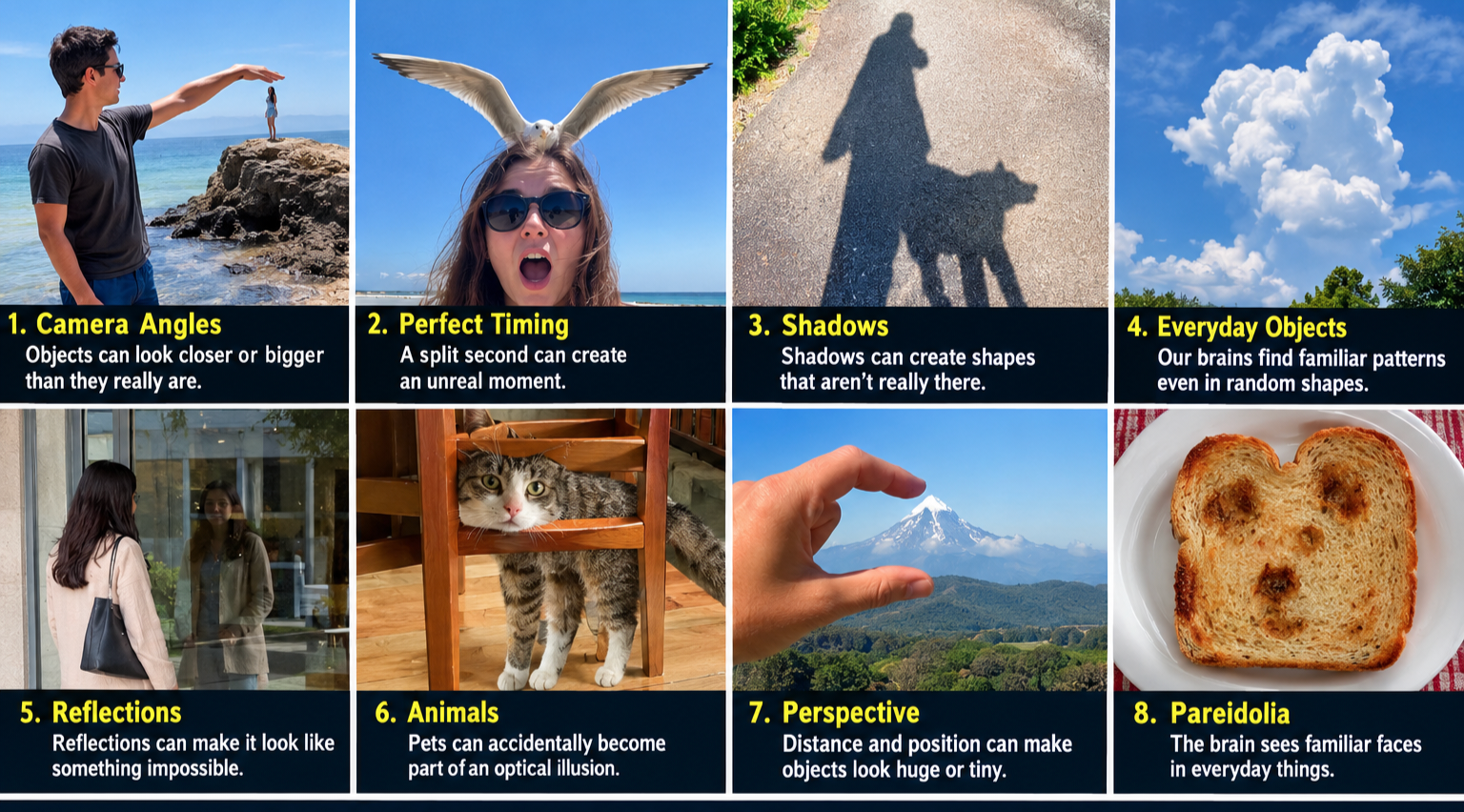
1. When Camera Angles Change Everything
One of the easiest ways to fool the human mind is through camera angles. A photograph taken from just the right position can make two separate objects appear connected.
For example, someone standing in the background might appear to have an unusually large head, while a person standing closer to the camera may look much smaller than expected. Sometimes, a distant object appears to be sitting directly on someone’s shoulder.
Nothing unusual is actually happening. The objects are simply positioned in a way that creates an optical illusion.
These pictures remind us that photographs capture only one particular viewpoint, not the complete reality of a situation.
2. Perfect Timing Creates Impossible Moments
Sometimes, a photograph becomes confusing because the camera captures a moment that lasts only a fraction of a second.
Imagine a bird flying behind someone’s head at exactly the right moment. Its wings might appear to belong to the person, creating a surprising visual effect. Similarly, a person jumping in the air might look as though they are floating above the ground.
These moments are completely natural, but their timing makes them appear extraordinary.
The best part is that nobody may notice anything unusual until the photograph is viewed afterward.
3. Shadows Can Play Tricks on Our Eyes
Shadows are another common source of visual confusion. Depending on the direction of the sunlight, ordinary objects can create shapes that look completely different from their real forms.
A tree shadow might resemble a person, while the shadow of a household object could look like an unfamiliar animal. Even a person’s shadow can appear much larger or strangely shaped depending on the angle of the light.
Our brains naturally try to recognize familiar patterns, which is why we sometimes see shapes that are not really there.
4. When Everyday Objects Look Like Something Else
Have you ever looked at a cloud and noticed that it resembled an animal or a familiar face? This experience is connected to a psychological phenomenon called pareidolia.
Pareidolia happens when the brain recognizes familiar patterns in random shapes or objects.
It can happen almost anywhere. A piece of toast may look like a face, a rock might resemble a sleeping animal, and the front of a car may appear to have human expressions.
These innocent visual surprises demonstrate how actively the human brain searches for recognizable patterns.
5. Reflections Create Confusing Images
Glass windows, mirrors, and shiny surfaces can produce some of the most confusing photographs.
A reflection in a window might make it appear as though someone is standing inside a building when they are actually outside. Water reflections can also create the impression that objects are floating upside down.
Sometimes, reflections from two different locations overlap, producing an image that seems impossible at first glance.
Once viewers understand how the reflection works, the mystery usually disappears.
6. Animals Can Accidentally Become Part of Optical Illusions
Animals frequently appear in photographs that confuse viewers.
A dog sitting behind a person might appear to have an unusually long body. A cat positioned behind a chair could look as though it has an extra pair of legs. Birds, pets, and wildlife can all create unexpected visual effects when they happen to stand in exactly the right place.
These photographs are particularly entertaining because the animals are simply going about their normal activities.
Their innocent expressions often make the pictures even more amusing.
7. Perspective Can Make Objects Look Bigger or Smaller
Perspective is one of the most powerful elements in photography.
When an object is positioned close to the camera, it can appear much larger than objects located farther away. This technique can make a small object look enormous or make a distant building appear tiny.
For example, someone holding their hand near the camera might appear to be touching the top of a distant mountain. Another person might look as though they are holding the sun between their fingers.
The reality is much simpler than the photograph suggests.
8. Why Do Our Brains Get Fooled?
The human brain processes enormous amounts of visual information every day. To understand everything quickly, it uses previous experiences, familiar patterns, and expectations.
However, this process sometimes leads to incorrect conclusions.
When a photograph contains unusual shapes, overlapping objects, or confusing perspectives, the brain may interpret the scene incorrectly before we have time to examine it carefully.
This is why looking at an image for a second time can completely change what we think we are seeing.
Conclusion: Never Believe Everything Your Eyes Tell You
Innocent photographs that create optical illusions are more than just entertaining pictures. They demonstrate how easily human perception can be influenced by perspective, lighting, timing, reflections, and familiar patterns.
What initially looks impossible may have a perfectly ordinary explanation. Sometimes, the secret is hidden in the background. Other times, it is simply a matter of looking at the picture from a different angle.
The next time you see a photograph that seems unbelievable, take another look before jumping to conclusions. You might discover that the truth is much simpler, funnier, and more surprising than your imagination first suggested.
After all, our eyes capture the image, but our brains decide what we think we are seeing.